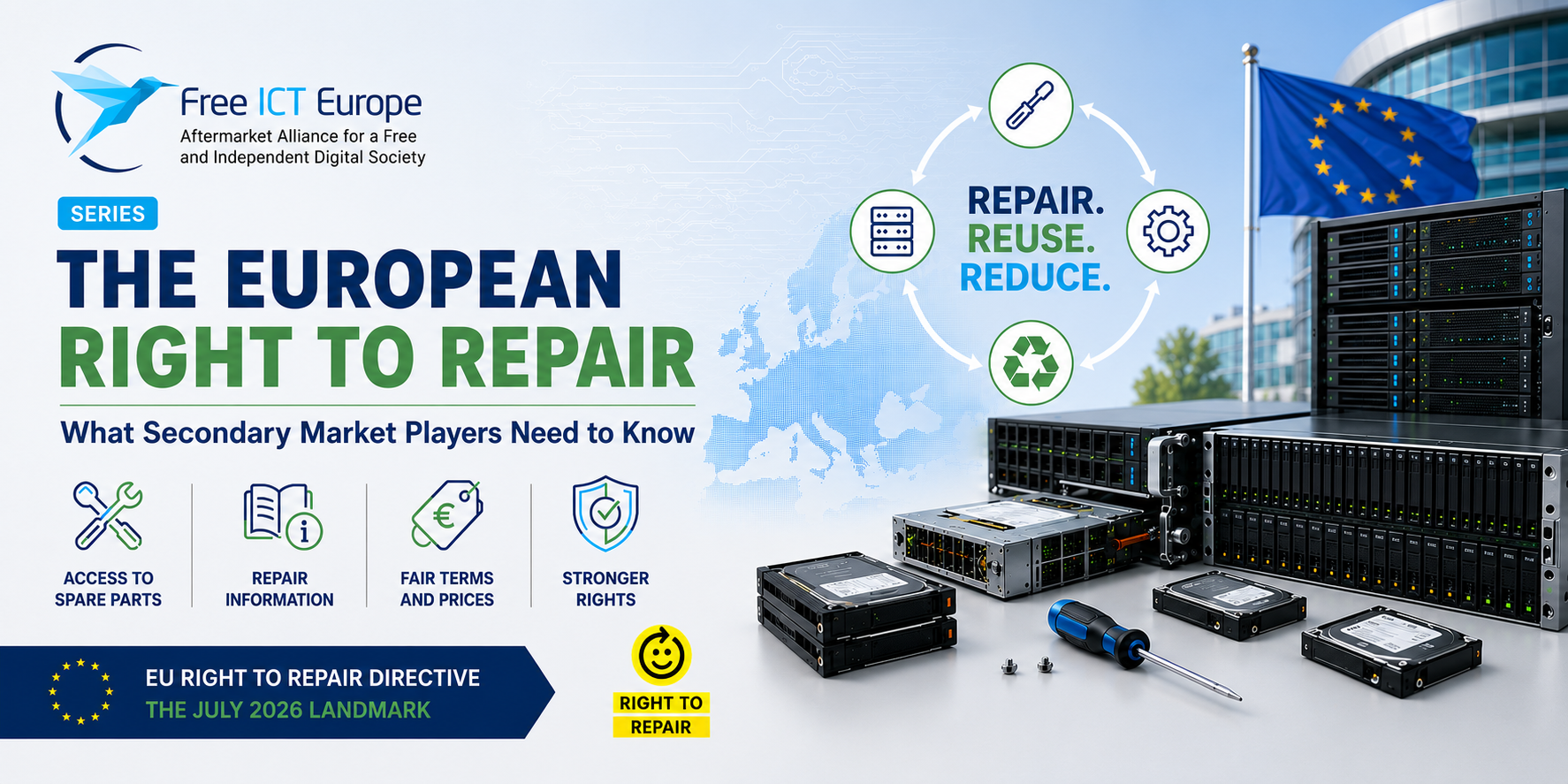
Right to Repair
Right to Repair
Part 1: The July 2026 Landmark: A New Era for Professional Repairers


Jan Hoogstrate, and
Mascha Visser
30 Second Summary
• The Right to Repair Directive comes into force on 31 July 2026.
• Professional repairers gain stronger legal rights.
• Manufacturers must provide better access to spare parts, repair information and repair tools.
• This marks an important step towards a more competitive and circular European repair market.
On 31 July 2026, the European Union's Right to Repair (R2R) Directive officially comes into force across all Member States. While much of the public discussion has focused on consumer rights, the Directive also marks an important milestone for professional repairers, refurbishment businesses and the independent IT aftermarket.
Manufacturers must provide professional repairers with access to spare parts, repair and maintenance information, as well as repair related software, firmware and other tools required to carry out repairs.
One of the Directive's strengths is its recognition of the term "professional repairer". Rather than distinguishing between independent repairers, maintenance providers and refurbishment businesses, it creates a single category that acknowledges the important role these organisations play in Europe's circular economy.
Member States must establish national registers for professional repairers, including B2B providers. For many businesses, registration will become an important gateway to accessing OEM repair information, diagnostic tools and spare parts.
The Directive also introduces greater market transparency. Manufacturers must publish indicative pre tax prices for spare parts in euros, making it easier for repair businesses to compare costs, compete fairly and demonstrate value to their customers.
By 31 July 2029, Member States must introduce at least one measure to encourage repair, although these initiatives are expected to focus primarily on consumer markets.
In Plain English
This is one of the biggest changes for independent repair businesses in years.
From July 2026, manufacturers can no longer keep repair information, spare parts and essential repair tools exclusively within their own networks. Professional repairers will have stronger legal rights to access what they need to repair products.
For companies repairing, maintaining or refurbishing IT equipment, this means more opportunities to compete fairly with manufacturers, offer customers more choice and help extend the life of valuable technology.
The Directive is not the complete solution, but it is an important next step towards a more open, competitive and circular IT market.
Why this matters
For years, independent repairers have argued that they can repair products just as safely and effectively as manufacturers, provided they have access to the right information, tools and spare parts.
The Right to Repair Directive begins to recognise that principle in law. While it will not solve every challenge overnight, it provides the independent repair sector with a much stronger foundation on which to build.
The Right to Repair is more than new legislation. It is the beginning of a more open, competitive and sustainable repair market for Europe.
This article is part of Free ICT Europe's six part series on the European Right to Repair Directive.